
Why Your Six-Month Checkup Matters More Than You Think
Most of us know we’re supposed to see the dentist twice a year. Fewer of us know what actually happens during that hour in the chair, and that uncertainty is one of the biggest reasons people put visits off. If you have ever wondered whether your checkup is “just a cleaning” or what the dentist is really looking for while you stare at the ceiling, this guide walks you through the whole appointment from the moment you check in to the moment you book your next visit.
At Renew Family Dentistry, Dr. Christopher Probst, Dr. Jiaying Ren, and Dr. Bryan Moore are the dentists in Frisco, TX, who built the practice around one idea: catching small problems while they’re still simple, affordable fixes. A six-month checkup is the single best tool for that. It’s not a formality. It’s a full health screening for your teeth, gums, bite, and mouth, and it’s the reason many of our patients never need a root canal, an extraction, or a dental emergency visit.
The numbers show why this matters. According to the CDC’s 2024 oral health surveillance report, nearly 21% of U.S. adults ages 20 to 64 have at least one permanent tooth with untreated decay. Early decay and early gum disease rarely hurt, so many people have no idea anything is wrong until the problem is bigger, more painful, and more expensive. Regular checkups are how Frisco dentists find those problems before you feel them.
Ready to improve your oral health? Call our Frisco dental office at (460) 633-0550 to schedule your consultation.
What Is a 6-Month Dental Checkup?
A six-month checkup is a routine visit that combines a comprehensive dental exam with a professional cleaning. It’s the foundation of general dentistry, which covers the everyday care that keeps your teeth and gums healthy: exams, cleanings, digital X-rays, oral cancer screenings, fillings, sealants, and gum disease care.
The six-month rhythm is not arbitrary. Plaque hardens into tartar (calculus) over a matter of weeks, and tartar cannot be brushed or flossed away. Early cavities and gum inflammation also progress on a timeline of months, not years. Seeing your dentist about every six months means we can spot changes early, clean away what home care cannot reach, and keep small issues from turning into major treatment.
Step 1: A Warm Welcome and a Quick Health History Review
Your visit starts at our front desk at 5575 Warren Pkwy, Suite 324, in Frisco. If you are a new patient, you can fill out forms online before you arrive. Either way, we start by reviewing your health history. This part matters more than people realize, because your overall health and your mouth are closely connected. Medications, pregnancy, diabetes, dry mouth, allergies, and recent changes in your health can all affect your teeth and gums, and they help us decide what to look for and how often you should come in.
This is also the moment to tell us about anything you have noticed since your last visit: a sensitive tooth, a bleeding gum, jaw soreness when you wake up, a sore spot that will not heal, or a filling that feels rough. Small details like these often point us straight to the problem.
Step 2: Digital X-Rays That Show What You Cannot See
Much of what can go wrong in your mouth happens where no one can see it: between teeth, under old fillings and crowns, below the gum line, and inside the jawbone. That is why X-rays are a regular part of a checkup, though not necessarily at every visit. Your dentist decides how often you need them based on your age, history, and risk.
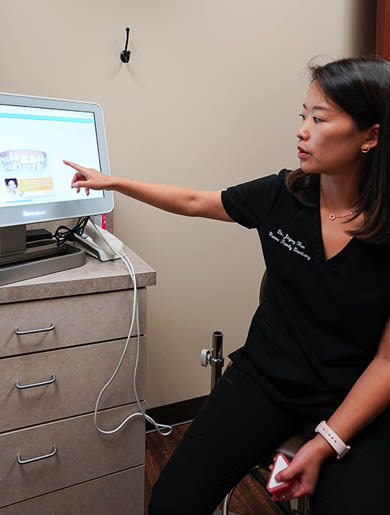
Renew Family Dentistry uses low-radiation digital X-rays that show up on screen right away, so your dentist can point out exactly what they see. Panoramic imaging gives a wider view of your jaws, sinuses, and wisdom teeth when it is needed. X-rays help us find:
- Cavities between teeth and under existing fillings
- Bone loss related to gum disease
- Infection at the root of a tooth
- Impacted or crowded wisdom teeth
- Cysts, growths, or other changes in the jaw
Step 3: A Comprehensive Exam of Your Teeth, Gums, and Bite
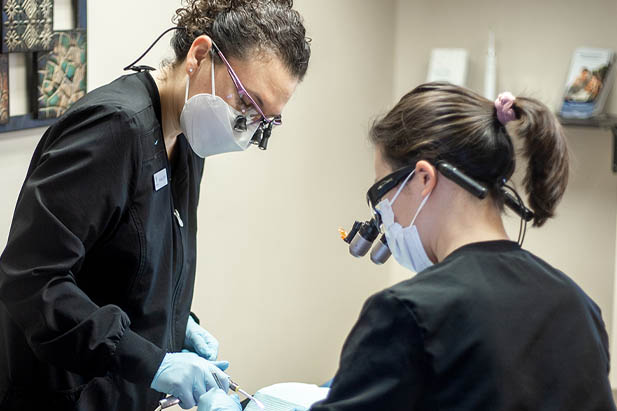
Next, one of our dentists performs a thorough exam. This is the heart of the checkup, and it covers much more than looking for cavities. Dr. Probst, Dr. Ren, or Dr. Moore will evaluate:
- Teeth: cavities, cracks, chips, worn enamel, and the condition of existing fillings, crowns, and bridges
- Gums: color, swelling, bleeding, recession, and the depth of the pockets around each tooth, which is a key sign of gum disease
- Bite and jaw: how your teeth come together, signs of clenching or grinding, and jaw joint comfort
- Soft tissues: your tongue, cheeks, palate, and the floor of your mouth
- Alignment and spacing: crowding, gaps, and shifting that may affect cleaning or comfort
We use an intraoral camera so you can see exactly what your dentist sees on a screen. A tiny crack or a failing edge on an old filling is hard to understand when someone just says “it needs attention.” Seeing it yourself makes every recommendation clearer, and it puts you in charge of the decision.
Step 4: An Oral Cancer Screening at Every Visit
It takes only a few minutes, but the oral cancer screening may be the most important part of your exam. Your dentist checks your lips, tongue, cheeks, throat, and neck for lumps, white or red patches, sores that do not heal, and other changes.
The American Cancer Society estimates about 60,480 new cases of oral cavity and oropharyngeal cancer in the U.S. in 2026, with about 13,150 deaths. Timing makes a major difference. According to the National Cancer Institute’s SEER program, localized oral cavity and pharynx cancer has a five-year relative survival rate of about 88%, but only about 26% of cases are diagnosed at that early stage. Because early oral cancer is often painless, a routine screening by a dentist is one of the best chances to catch it while it is highly treatable.
Step 5: A Professional Cleaning That Does What Brushing Cannot
Even the most careful brusher and flosser leaves behind some plaque, and once it hardens into tartar, only professional tools can remove it. During your cleaning, we:
- Remove plaque and tartar from above and below the gum line, including the hard-to-reach spots along the back teeth and between teeth
- Polish your teeth to remove surface stains from coffee, tea, red wine, and everyday foods
- Floss and rinse to clear away debris and leave your mouth feeling fresh
- Review your home care and show you any areas you may be missing
A professional cleaning protects far more than your smile. Plaque and tartar left along the gum line irritate the gums and are a leading cause of gingivitis, the earliest and most reversible stage of gum disease. If we find that your gums need more than a standard cleaning, we will explain your options, including gum disease treatments offered right here in Frisco.
Step 6: Your Results, Your Questions, and a Plan With No Pressure
After your exam and cleaning, your dentist sits down with you to explain what they found in plain language. If everything looks healthy, we will tell you so and send you on your way. If something needs attention, we will show you the X-ray or camera image, explain what is happening and what could happen if it is left alone, and walk through your options. Some findings can simply be watched over time. Others call for treatment, such as tooth-colored fillings, dental sealants, a custom night guard, or a tooth extraction when a tooth cannot be saved.
You will never be pushed to decide on the spot. Our team is also happy to answer questions about cost, financing, and insurance before you commit to anything, so you know what to expect. You can learn more on our payments and financing page.
What Your Checkup Can Catch Before It Becomes a Bigger Problem
The real value of a checkup is what does not happen because of it. Here are common issues our Frisco dentists find early:
- Small cavities that need a simple filling instead of a crown or root canal later
- Early gum disease that can be reversed with better cleaning and home care
- Cracked or worn teeth caused by clenching, grinding, or biting hard foods
- Old fillings and crowns that are leaking or breaking down
- Signs of teeth grinding that may call for a night guard before enamel wears away
- Wisdom teeth problems that can be planned for instead of becoming an emergency
- Suspicious spots in the mouth, throat, or tongue that need follow-up
Checkups for Kids, Teens, and the Whole Family
One reason families choose a family dentistry practice is the convenience of seeing one office for everyone, from a child’s first cleaning to a grandparent’s denture care. For children and teens, a checkup also includes prevention that adults sometimes need too.
For example, dental sealants are thin protective coatings painted on the chewing surfaces of back teeth. The CDC reports that sealants prevent about 80% of cavities over two years in the back teeth, where most cavities form, yet only about 42% of children ages 6 to 11 have them. The same CDC page notes that adults ages 20 to 34 have more untreated back-tooth cavities than any other age group, so sealants are worth asking about at any age. Fluoride treatments add another layer of protection for kids and adults who are prone to decay.
If your child needs a custom mouth guard for fall sports, your checkup is a good time to ask about that, too.
How Long Does a 6-Month Checkup Take, and Who Needs to Come In More Often?
Most routine visits take about an hour. Your first visit may run a little longer because it includes a full health history, a complete set of X-rays, and a more detailed exam.
Six months is the standard recommendation, but it is not one-size-fits-all. Your dentist may suggest more frequent visits if you:
- Have gum disease or a history of it
- Are prone to cavities or have had many fillings
- Smoke or use tobacco products
- Have diabetes or another condition that affects healing and gum health
- Are pregnant
- Have a dry mouth, often caused by medications
- Have braces, clear aligners, or other dental work that is harder to keep clean
If you have dental anxiety, please tell us. We offer sedation dentistry, including nitrous oxide and oral conscious sedation, so that even the most nervous patients can get the care they need comfortably.
How to Get the Most Out of Your Next Checkup
- Bring your questions. Write down anything you have noticed, even if it seems minor.
- Share any health changes, including new medications, pregnancy, or a new diagnosis.
- Brush and floss as usual before you come in. You do not need to deep clean beforehand.
- Bring your insurance information if you have it, or ask our team about financing and our membership plan if you do not.
- Book your next visit before you leave. The easiest way to keep your six-month schedule is to schedule your next appointment while you are still in the office.
Schedule Your Six-Month Checkup with Our Frisco Dentists Today
If it has been six months, or six years, since your last dental visit, now is a great time to get back on track. At Renew Family Dentistry, Dr. Christopher Probst, Dr. Jiaying Ren, and Dr. Bryan Moore provide thorough, comfortable, prevention-first care for the whole family. Our Frisco dentists take the time to explain what we see, answer your questions, and give you honest options with no pressure.
Call us at (469) 633-0550 or request an appointment online to schedule your checkup. We welcome patients in Frisco, The Colony, Frisco Lake communities, Little Elm, Richwoods, and Deerfield, TX.