

Why All-on-4 vs. Dentures is a Matter of Long-Term Value
If you’re comparing All-on-4 dental implants to traditional dentures, the sticker price is usually the first thing that grabs your attention. But the number that actually matters more over the long run isn’t the upfront cost—it’s the lifespan. Dentures typically need to be replaced every 5 to 10 years. All-on-4 implants, when properly placed and maintained, are built to last 15 to 25 years or more.
At Renew Family Dentistry in Frisco, TX, Dr. Christopher Probst and Dr. Jiaying Ren walk patients through this exact comparison every week—because most people who come in asking about dentures have never been shown what a fixed, implant-supported alternative actually looks like over a lifetime. Below, we break down what the research says, what that 15 to 25-year gap really means for your jawbone and your wallet, and how to know which option fits your situation.
Ready to learn more about this restorative option? Call our Frisco dental office at (460) 633-0550 to schedule your dental appointment.
What Happens to Your Jawbone With Dentures—and Why It Doesn’t Stop
Traditional dentures rest on top of the gums and are held in place with suction or adhesive. What they don’t do is stimulate the jawbone underneath. Natural tooth roots transmit chewing forces directly into the bone, which signals the body to maintain that bone’s density. Once the roots are gone and nothing replaces that stimulation, the jawbone begins to resorb—shrink and reshape—a process that continues for as long as someone wears removable dentures.
This is why many longtime denture wearers notice their bite feels looser over time, their dentures need repeated relining, and their lower face gradually takes on a sunken appearance. It isn’t a sign of doing something wrong; it’s a predictable biological response to the loss of bone stimulation, and it’s one of the most common reasons that Frisco dentists, Dr. Probst and Dr. Ren, see patients return every few years for denture adjustments or full replacements.
All-on-4 implants work differently. Because the four titanium posts are anchored directly into the jawbone, they transmit chewing forces the same way natural roots do. Over the healing period, the bone fuses to the implant posts in a process called osseointegration—creating a foundation that preserves bone density rather than allowing it to disappear.
The Data: How Long Does Each Option Actually Last?
It’s easy to find marketing claims about implant longevity. It’s more useful to look at what long-term clinical research actually shows.
One of the most frequently cited studies in this field followed All-on-4 patients for up to 18 years and found a cumulative prosthetic survival rate of 98.8 percent, with individual implant survival at 93 percent over that same period. A separate 10-year follow-up study reported a 94.8 percent implant survival rate and a 99.2 percent prosthesis survival rate. In other words, the vast majority of patients who receive All-on-4 implants are still using that same fixed arch of teeth well over a decade later.
Dentures don’t have the same track record because they aren’t designed to last that long in the first place. A removable denture typically needs replacement or significant relining every 5 to 10 years as the jawbone continues to change shape underneath it—meaning a patient in their 60s who chooses dentures may go through two, three, or more replacement sets over the following decades.
- Typical lifespan: All-on-4 implants are 15–25+ years, while traditional dentures are 5–10 years.
- Stability: All-on-4 implants are fixed and non-removable, whereas traditional dentures are held by suction or adhesive.
- Bone preservation: All-on-4 implants stimulate the jawbone; traditional dentures allow bone loss to continue.
- Daily eating: All-on-4 Implants have no restrictions, but traditional dentures are often limited to sticky, hard, or chewy foods.
- Maintenance: All-on-4 Implants are brushed and flossed like natural teeth; traditional dentures must be removed nightly, soaked, and relined periodically.
Why the Real Cost Comparison Isn’t What It Looks Like at First
All-on-4 implants in the Frisco and North Dallas area typically range from $20,000 to $30,000 per arch — a number that can look steep next to a denture’s $1,500 to $3,500 starting price. But that comparison only tells half the story.
Because dentures need replacing roughly every 5 to 10 years, the true cost of wearing dentures over 20 years includes multiple replacement sets, ongoing relines, adhesives, and repair visits. When you add that up, the total cost of two decades of denture ownership can approach—and sometimes rival—the one-time investment of All-on-4, without any of the bone-preserving benefits implants provide. Dr. Probst and Dr. Ren review a full written cost breakdown with every patient at their consultation, so there are no surprises either way.
Who Tends to Benefit Most From Making the Switch
Patients who’ve been wearing dentures for years and are frustrated by slipping, sore spots, or the inability to eat what they want are often excellent All-on-4 candidates. So are patients who are about to lose their remaining teeth and want to avoid dentures altogether. Candidacy comes down to a few key factors our Frisco dentists evaluate directly:
- Missing most or all teeth in one or both arches
- Sufficient jawbone density (grafting can often address deficiencies when needed)
- Healthy gum tissue, free of active, untreated periodontal disease
- Non-smoker, or willing to pause smoking during healing
- Well-managed overall health
If you’ve been told in the past that you don’t have enough bone for implants, it’s worth a second opinion. The angled placement used in the All-on-4 technique reaches denser bone toward the back of the jaw that traditional implant approaches often can’t access—which means many patients who were told “no” elsewhere may still be candidates here.
Frisco Patients Have a Local Team That Handles the Entire Process In-House
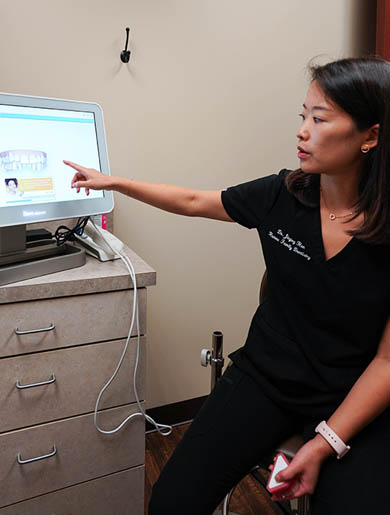
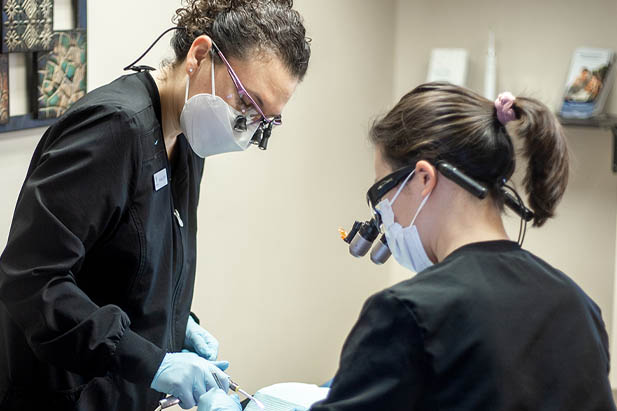
One of the reasons Renew Family Dentistry stands out among Frisco dentists offering All-on-4 is that every step—the initial 3D imaging consultation, implant placement, and final arch delivery—happens at the same Frisco office. There’s no bouncing between outside specialists or coordinating separate practices. Dr. Ren also holds a Fellowship in the Academy of General Dentistry, a credential fewer than 10 percent of U.S. dentists earn, which requires 500+ hours of advanced training beyond dental school.
We welcome patients from Frisco, The Colony, Frisco Lake communities, Little Elm, Richwoods, and Deerfield, TX, and our Frisco office is designed to make the entire All-on-4 process, from that first consultation through your final permanent arch, as straightforward as possible.
Ready for a Smile That Actually Lasts? Talk to Your Frisco All-on-4 Dentists Today
If you’re weighing dentures against All-on-4 implants, the honest answer is that the right choice depends on your bone health, your goals, and how you want to be eating and smiling ten or twenty years from now. Dr. Christopher Probst and Dr. Jiaying Ren are ready to walk you through your options, review your imaging, and give you a clear, written breakdown of what All-on-4 would look like for your specific case.
Call Renew Family Dentistry at (469) 633-0550 or request an appointment online to schedule your All-on-4 consultation at our Frisco office, located at 5575 Warren Parkway, Suite 324, Frisco, TX.